Occultation by the dwarf planet Haumea


The observation of the occultation by Haumea on May 4th, 2026 represented a particularly relevant scientific opportunity for the study of trans-Neptunian objects. These types of events make it possible to obtain extremely precise information about the size, shape, density, and environment of these distant bodies by analysing the momentary disappearance of a star as the object passes in front of it. In the case of Haumea, the scientific interest was even greater due to its exceptional nature: an अत्यंत elongated dwarf planet, with rapid rotation, two known satellites, and a ring system discovered in 2017.
Predictions for this event also indicated that the occultation produced by the rings could be observed at considerably larger distances than the occultation caused by the main body itself, significantly expanding the region of scientific interest. The international campaign also emphasized the technical difficulty of detecting these events, especially those associated with the rings, characterized by very brief and shallow drops in brightness. Telescopes with apertures of at least 0.4 m and acquisition rates above 10 Hz were recommended.
The observation was carried out from Astrocamp using a PlaneWave CDK12.5 together with a QHY268 cooled to −10 °C and equipped with a Luminance filter. The images were acquired using SharpCap with 1-second exposure times, 2×2 binning, and a gain setting of 160. The integration time was selected as the minimum compatible with a sufficient signal-to-noise ratio to attempt detection of the occultation, taking into account that the combined magnitude of the star and Haumea was approximately V = 14.6. During the observation, an SNR of approximately 30 was achieved. A total of 495 FITS images were recorded over a period of 8.27 minutes.

The centerline of the occultation path was located over North Africa, and the event generated enormous scientific interest, with observing stations announced from Europe to China.
The observing station was located approximately 1215 km from the occultation centerline. At that distance, no occultation by the main body of Haumea was expected, but there was still the possibility of recording the passage of the rings, whose projected diameter is considerably larger. The difficulty of the challenge was extreme: in addition to working with a relatively modest aperture for this type of event, the exposure time used was 1 second, whereas recommendations for ring events indicated exposure times shorter than 100 ms in order to avoid smoothing or completely losing the signal.
Despite these limitations, the observation was successful. The first contact of the rings with the star was recorded at approximately 20:19.2 UT, detecting a flux drop temporally consistent with other observations obtained using larger-aperture telescopes. The second contact could not be clearly identified, possibly due to the excessively long integration time employed, which would have smoothed the signal until it became indistinguishable from the photometric noise.

The following figure shows the light curve obtained during the observation. Although the recorded signal is extremely subtle, the timing of the first contact matches both the predictions and independent observations obtained from other observing stations.
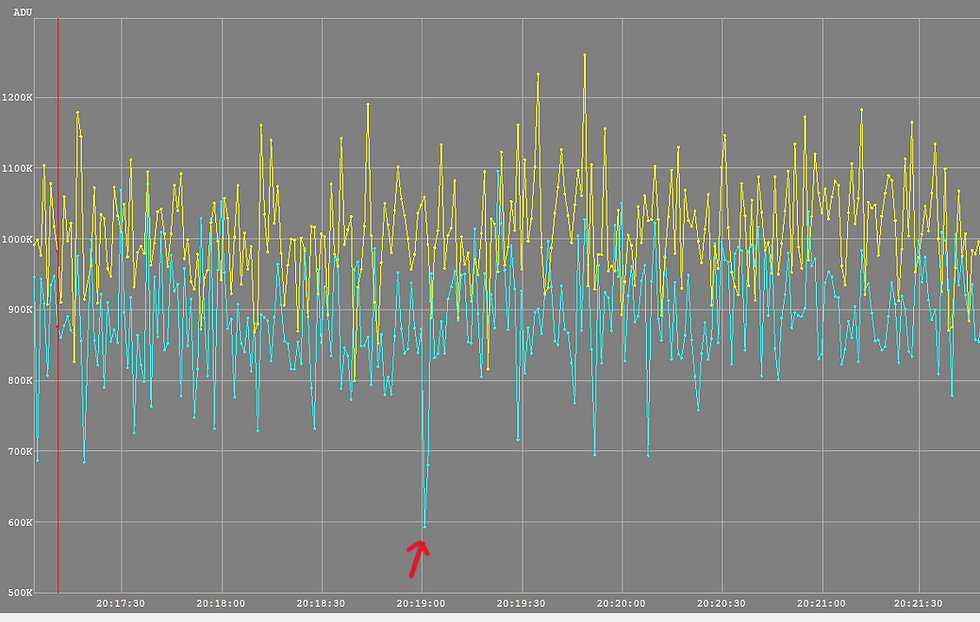
As an additional verification, and since the stellar field contained enough stars to perform plate solving and photometry using multiple reference stars, Tycho Tracker was used to independently measure the flux drop. The following figure shows the result.

This result once again demonstrates how, in observational astronomy, careful attention to every instrumental and methodological detail — together with a certain degree of luck — can make it possible to obtain scientific results far beyond what might be expected, even with non-optimal equipment and observing conditions.


Comentarios